
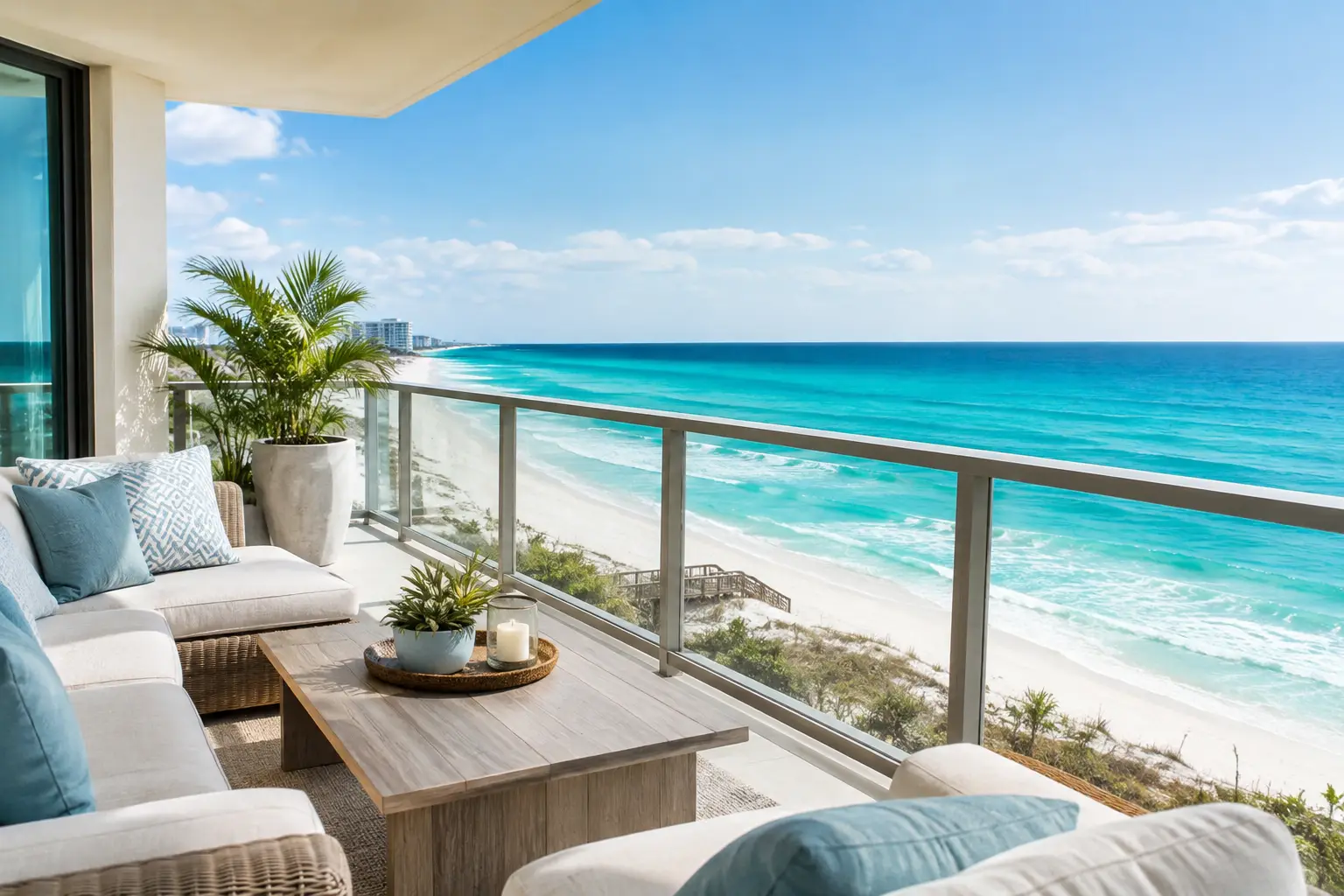
A gulf view alone no longer carries a luxury vacation rental. Guests paying premium nightly rates along 30A and Panama City Beach expect a complete experience: refined design, walkable location, dependable amenities, and a property that looks as strong in person as it does online. Luxury rental demand remains a meaningful force across the Emerald Coast, but it is increasingly selective. Owners and investors who understand that distinction are better positioned to protect income and long-term asset value.
For high-value coastal real estate, demand is not simply a question of whether travelers are coming to the beach. The more useful question is which homes command attention, convert bookings, sustain rate integrity, and remain competitive as new inventory enters the market.
What Is Driving Luxury Rental Demand?
The Emerald Coast benefits from several demand sources that do not rely on one visitor profile. Families return annually for school breaks and holidays. Affluent second-home buyers rent before they purchase. Multi-generational groups seek large homes that provide privacy without sacrificing proximity to the beach. Corporate travelers, wedding groups, and seasonal guests also support demand outside the peak summer window.
Luxury travelers are often willing to pay more for certainty. They want private beach access or a short, uncomplicated walk to the sand; meaningful outdoor living space; a heated pool; quality furnishings; reliable parking; and enough bedrooms and bathrooms for the group they are bringing. In markets such as Rosemary Beach, Alys Beach, WaterColor, Seaside, Grayton Beach, and selected gulf-front or amenity-rich areas of Panama City Beach, location remains the first filter. Property quality determines whether that location earns a premium.
The strongest demand tends to concentrate around homes that reduce friction. A five-bedroom property can outperform a larger home if its floor plan works for multiple families, its kitchen supports group meals, its pool area feels private, and its beach logistics are simple. Conversely, an expensive home with dated interiors, limited parking, weak outdoor space, or an awkward beach route can lose ground quickly when guests compare options.
Luxury Rental Demand Is Not the Same as Broad Rental Demand
A healthy visitor market does not automatically translate into high performance for every luxury rental. The upper end of the market has a narrower audience and a higher standard of execution. Guests evaluating a $15,000 to $30,000 weekly stay are comparing more than bedroom count. They are weighing design, convenience, reputation, photography, reviews, and the perceived quality of the entire stay.
That creates a useful divide between properties that are merely large and properties that are genuinely premium. Square footage matters, but it is rarely enough on its own. Gulf-front positioning, deeded beach access, architectural character, professionally designed interiors, and resort-style outdoor amenities can support higher rates because they create a clear reason to choose one home over another.
Seasonality also matters. Summer remains a critical revenue period, yet a property should not be underwritten on peak weeks alone. Spring break patterns, fall events, winter stays, owner use, weather volatility, and local restrictions can all affect annual income. An investor who assumes full occupancy at top-tier rates throughout the year is not analyzing demand. They are modeling an ideal outcome.
Rate Strength Matters More Than a Headline Revenue Number
Gross rental revenue is a useful starting point, not a final investment conclusion. A home may show impressive revenue because it is heavily discounted, booked aggressively during low-demand periods, or managed with a strategy that prioritizes occupancy over rate. That approach can create wear, increase operating costs, and weaken the property’s premium positioning over time.
A more disciplined review considers average daily rate, occupancy by season, booking pace, repeat-guest behavior, cancellation patterns, management fees, maintenance, insurance, utilities, reserves, and owner-blocked dates. The objective is to understand the quality of income, not simply the size of one annual total.
For sellers, this distinction is equally important. Well-documented rental performance can strengthen a listing, but only if the numbers are presented accurately and in context. Buyers of high-value coastal assets are increasingly sophisticated. They want to see a credible revenue story, a realistic expense profile, and a clear explanation of what makes the property durable in its competitive set.
Where Demand Is Most Resilient
Luxury rental demand generally holds up best where a property offers a combination of scarcity and usability. Gulf-front homes remain compelling because direct water access is difficult to replicate. Homes close to the beach in established 30A communities often benefit from walkability to dining, shopping, and family activities. Larger homes with pools and flexible sleeping arrangements can appeal to the group-travel segment, particularly when they are positioned near access points and not dependent on a long drive to reach the beach.
Panama City Beach presents a different, but potentially attractive, value proposition. Certain properties can offer more space, stronger amenity packages, and a lower acquisition basis than some 30A submarkets. The trade-off is that performance can vary more widely by building, street, beach access, property condition, and the surrounding guest experience. A broad market label is not enough. Block-level analysis matters.
In either market, the most resilient assets tend to have a story that remains compelling after the booking calendar changes. They appeal to renters, but they also make sense as personal-use properties and future resale assets. That dual appeal can be especially valuable when buyer demand shifts from pure yield-seeking toward lifestyle-driven ownership.
How Owners Can Protect Premium Positioning
Luxury rentals require active stewardship. The property that performed well three years ago may need a targeted renovation, refreshed furnishings, upgraded technology, or a sharper marketing strategy to maintain its place in the market. Guests notice details: worn upholstery, inconsistent linens, aging outdoor furniture, poor lighting, and kitchens that photograph well but function poorly for a large group.
Owners should evaluate their property against its true competitive set at least annually. This is not every rental in the area. It is the homes a guest would realistically consider at the same rate range, during the same travel period, with comparable beach access and bedroom capacity. That comparison often reveals whether a renovation is cosmetic, revenue-producing, or unnecessary.
Not every upgrade pays back equally. Adding a pool heater may improve shoulder-season appeal. Reconfiguring outdoor space can materially change guest perception. Replacing serviceable finishes solely to follow a fleeting design trend may not produce the same return. The right decision depends on acquisition basis, target guest, current rate position, expected holding period, and the property’s resale strategy.
Professional management is another critical variable. Response time, housekeeping consistency, maintenance coordination, photography, pricing discipline, and guest communication directly affect reviews and repeat bookings. An exceptional property can still underperform if operations fail to support the rate it is trying to command.
A Better Way to Underwrite Coastal Rental Opportunities
Before acquiring a luxury rental, buyers should pressure-test the opportunity under multiple scenarios. Start with conservative rental assumptions based on comparable properties, not the seller’s best year or a generic online estimate. Then account for operating expenses that rise with a premium home, including insurance, pool service, landscaping, repairs, furnishings, property management, and capital reserves.
It is also prudent to distinguish between a property’s rental value and its personal value. A buyer who plans to use the home during peak weeks may accept a different financial outcome than an investor seeking maximum cash flow. Neither approach is wrong, but mixing the two without acknowledging the trade-off often leads to disappointment.
Local rules, association restrictions, rental minimums, parking limits, and beach access arrangements deserve careful review before closing. These factors can materially influence both rental operations and resale appeal. A property is only as investable as its ability to operate within the rules that govern it.
Venture South Real Estate approaches these decisions through both a lifestyle and performance lens: identifying the attributes that drive guest demand while testing whether the income assumptions support the acquisition strategy.
The Opportunity Is in Selectivity
The coastal luxury rental market is not defined by a single occupancy figure or a one-size-fits-all revenue multiple. It is shaped by property-specific advantages, guest expectations, market timing, and disciplined execution. Demand can be strong while competition is equally strong. Both conditions can be true at once.
For owners, the priority is maintaining a property that earns its premium every time a guest compares it with the alternatives. For buyers, the priority is acquiring an asset whose location, condition, operations, and long-term desirability work together. The best coastal investments are not simply the homes that rent well this season. They are the homes positioned to remain relevant when the next season looks different.